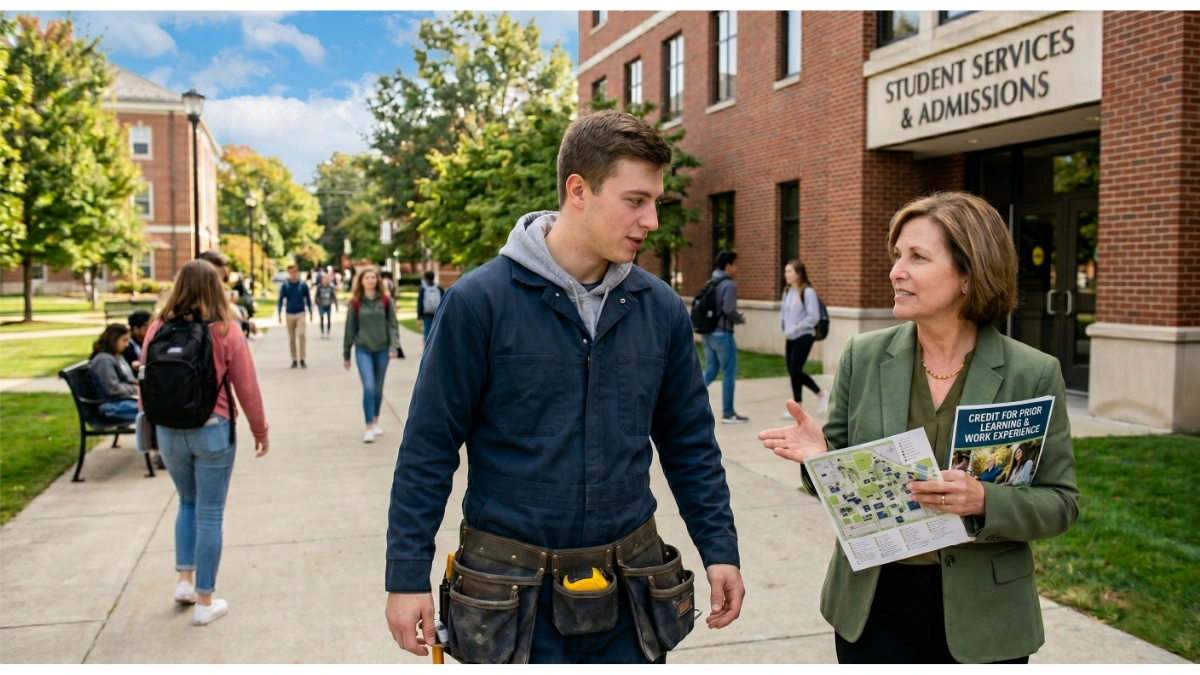
You spent years mastering a trade. You showed up, did the work, and built real skills. Now you're thinking about college, and you're staring at a course catalog full of classes that cover things you already know how to do.
Here's something a lot of apprentices don't realize: that experience may already be worth college credit. You don't always have to start from scratch.
This article breaks down exactly how to convert apprenticeship experience into college credit, who accepts it, and what steps to take.
Do Apprentices Earn College Credit?
The short answer is yes. Sometimes automatically, sometimes with a little work on your end.
According to the U.S. Department of Labor's Apprenticeship.gov, most registered apprenticeship programs include related training instruction through community colleges and four-year institutions. Many apprenticeship sponsors work directly with those colleges to make credit transfer possible.
The catch? It depends on your program and your target school. Some apprentices graduate with a stack of transferable credits they never knew they had. Others have to make the case themselves.
Step 1: Check for Pre-Existing College Partnerships
Before you do anything else, check whether your apprenticeship sponsor already has a deal in place with a college.
Some programs have formal articulation agreements. Your training maps directly to specific courses at a partner institution. If that's the case, you may not need to do much more than submit your completion certificate.
According to New America, some community colleges have established credit articulation agreements with apprenticeship programs, though these remain less common than standard course enrollment.
How to check:
Ask your apprenticeship sponsor or training coordinator
Search the college's transfer credit or workforce partnership page
Call the admissions or registrar's office and ask directly
A student who finishes a 4-year electrical apprenticeship might contact their local community college and find out their sponsor already has a standing agreement. They could walk in with 18 credits on the books without any additional paperwork.
Step 2: Get Your Training Formally Evaluated
If there's no college partnership in place, the next step is to find out whether your training program has been formally reviewed and given a credit recommendation.
Some apprenticeship sponsors have already gone through this process with a recognized evaluation body. If yours has, the college may accept those recommendations directly when you enroll. Ask your sponsor whether any formal evaluation has been done and whether they have documentation you can submit.
If no evaluation exists, you can still make the case yourself. Gather your training records, course outlines, competency logs, and any certifications earned during the apprenticeship. Colleges use this documentation to assess how your training lines up with their course requirements.
What to pull together:
Completion certificate from your apprenticeship program
Training outlines or syllabi from your sponsor
Competency or skills logs showing hours and tasks completed
Any industry certifications earned during the program
The more clearly you can show what you learned and how long you trained, the stronger your case will be when you sit down with an admissions or PLA coordinator.
Step 3: Ask About Prior Learning Assessment (PLA)
PLA is the broadest tool available to you, and the least understood.
Prior learning assessment is a process colleges use to evaluate what you've learned outside the classroom and translate it into credit. According to the Center for American Progress, PLA measures what a student has learned outside of the college classroom and determines the equivalent number of college credits, saving adult learners from paying for courses in subjects they already know.
PLA methods include:
Portfolio assessment: you document your skills and knowledge, and faculty review it
Challenge exams: you test out of a course
Employer training evaluations: the college reviews your apprenticeship training directly
Formal credit transcripts: credit recommendations from recognized evaluation bodies submitted directly to the college
There are credit caps to be aware of. SUNY Canton, for example, caps PLA at 15 credits for an associate degree and 30 for a bachelor's. Most institutions set similar limits.
If a student is a graduate of a healthcare apprenticeship, a portfolio review at a university with a dedicated PLA office could yield 24 credits toward a bachelor's in health services, knocking a full year off their degree.
Step 4: Target "Adult-Friendly" Colleges
Not every college handles prior learning the same way. Some have built entire systems around it. Others barely acknowledge it exists.
If you're an apprenticeship graduate, your time and money go further at schools designed for working adults.
What to look for:
A dedicated PLA or prior learning office
Published policies with clear credit caps and accepted methods
Accelerated course formats (evening, weekend, online)
Staff who advise adult and non-traditional learners
Employer discount or tuition assistance programs
Schools like SUNY Empire State University, Charter Oak State College, and Thomas Edison State University have built reputations for this. They're not the only options, but they're a good benchmark for what a strong PLA program looks like.
According to a national study involving 72 universities and conducted by the Council for Adult and Experiential Learning, adult learners who entered with prior learning credits stayed enrolled longer and had a higher chance of completing their degree.
Getting credit for what you already know doesn't just save money. It actually improves your odds of graduating.
Community Colleges: Often the Best Starting Point
If you're not ready to commit to a four-year degree, community colleges are worth a serious look, especially if you completed a trade or technical apprenticeship.
The California Community Colleges Chancellor's Office launched an initiative making current and completed apprentices in priority industry sectors eligible for college credit, with a pathway from pre-apprenticeship certificates through to associate and bachelor's degrees.
In Illinois, the College of DuPage runs apprenticeship programming across 15 credit-bearing certificates and degree programs. Many are stackable. Start with a certificate, move to an associate degree, and continue to a bachelor's if you want.
The strongest community college partnerships currently cover:
Construction trades (electrical, plumbing, HVAC)
Industrial manufacturing
Healthcare
Early childhood education
Tech and business apprenticeships are catching up, but coverage varies a lot by state.
For example, a student who is enrolled at a community college with U.S. Department of Labor Apprenticeship Ambassador status after a 3-year HVAC apprenticeship can have their on-the-job training count toward hands-on lab requirements, finishing an associate degree in as little as 18 months.
Degree Apprenticeships: Earning Credit While You Work
Worth mentioning separately: if you're currently in an apprenticeship (not just looking back at a completed one), degree apprenticeship programs let you earn credit in real time.
These programs integrate academic coursework directly into your work schedule. You're employed, you're learning, and you're building toward a degree all at once.
Rhode Island enacted legislation in 2023 allowing individuals to earn academic credit through registered apprenticeships that count toward a bachelor's degree at public institutions. Similar models are spreading across other states.
New America describes a competency-based approach where on-the-job training is aligned with academic credit requirements through the college's prior learning systems. Your work directly substitutes for coursework rather than running parallel to it.
If your employer offers or sponsors a degree apprenticeship, take it seriously. It's one of the few ways to finish a degree without taking on significant debt.
What to Do This Week
You don't need to have everything figured out before you take action. Start here:
Contact your apprenticeship sponsor. Ask if they have college partnerships or formal training evaluations on file.
Check whether your program has been formally evaluated. Ask your sponsor or contact the college registrar directly.
Call two or three colleges you're considering. Ask specifically about PLA options and whether they work with apprenticeship graduates.
Gather your documentation. Training logs, hours, certifications, journeyman cards. You'll need these regardless of which route you take.
The worst outcome is spending money on classes covering material you already know. A few phone calls upfront can save you a year of tuition.
 Choosing a U.S. Graduate School That Matches Your Goals
 5 ESL Teaching Trends Colleges Are Watching in 2026
 The Rise of Digital Diplomas
 U.S. Universities Are Opening Campuses Abroad to Survive. Will It Work?
 How Universities Use Social Media to Recruit International Students and Improve Learning in 2026